
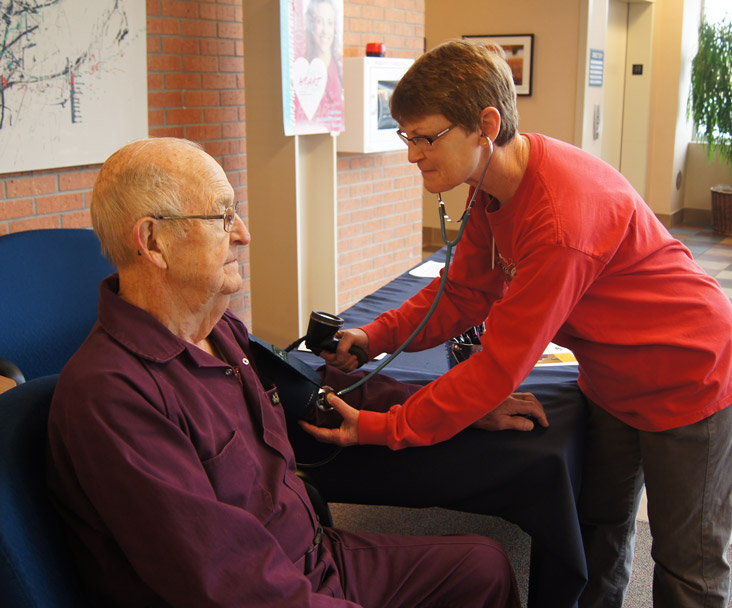
The Cardiac Rehab Department offered free blood pressure checks this morning in front of the Mark A. Chapman Wellness Center. Today they also encourage people to wear red to support women living longer, stronger lives.
American Heart Association - High blood pressure, also known as HBP or hypertension, is a widely misunderstood medical condition. Some people think that those with hypertension are tense, nervous or hyperactive, but hypertension has nothing to do with personality traits. The truth is, you can be a calm, relaxed person and still have HBP.
Blood Pressure Facts
Let's look at the facts about blood pressure so you can better understand how your body works and why it is smart to start protecting yourself now, no matter what your blood pressure numbers are.
By keeping your blood pressure in the healthy range, you are:
- Reducing your risk of the walls of your blood vessels walls becoming overstretched and injured.
- Reducing your risk of having a heart attack or stroke; and developing heart failure, kidney failure and peripheral vascular disease.
- Protecting your entire body so that your tissue receives regular supplies of blood that is rich in the oxygen it needs.
WHAT HAPPENS IN THE BODY WHEN BLOOD PRESSURE IS HIGH?
Blood pressure measures the force pushing outwards on your arterial walls.
The organs in your body need oxygen to survive. Oxygen is carried through the body by the blood. When the heart beats, it creates pressure that pushes blood through a network of tube-shaped arteries and veins, also known as blood vessels and capillaries. The pressure --- blood pressure --- is the result of two forces. The first force occurs as blood pumps out of the heart and into the arteries that are part of the circulatory system. The second force is created as the heart rests between heart beats. Blood pressure is typically recorded as two numbers, Systolic and Diastolic.
What is the AHA recommendation for healthy blood pressure? Your doctor should evaluate blood pressure readings.
- Normal Blood Pressure: Systolic (less than 120) and Diastolic (less than 80).
- Prehypertension Blood Pressure: Systolic (120-139) or Diastolic (80-89).
- High Blood Pressure Stage 1: Systolic (140-159) or Diastolic (90-99).
- High Blood Pressure Stage 2: Systolic (160 or higher) or Diastolic (100 or higher).
- Hypertensive Crisis: Systolic (Higher than 180) or Diastolic (Higher than 110).
How is high blood pressure diagnosed?
Your healthcare providers will want to get an accurate picture of your blood pressure and chart what happens over time. Starting at age 20, the American Heart Association recommends a blood pressure screening at your regular healthcare visit or once every 2 years, if your blood pressure is less than 120/80 mm Hg.
Your blood pressure rises with each heartbeat and falls when your heart relaxes between beats. While BP can change from minute to minute with changes in posture, exercise, stress or sleep, it should normally be less than 120/80 mm Hg (less than 120 systolic AND less than 80 diastolic) for an adult age 20 or over. About one in three (33.5%) U.S. adults has high blood pressure.
If your blood pressure reading is higher than normal, your doctor may take several readings over time and/or have you monitor your blood pressure at home before diagnosing you with high blood pressure. A single high reading does not necessarily mean that you have high blood pressure.
However, if readings stay at 140/90 mm Hg or above (systolic 140 or above OR diastolic 90 or above) over time, your doctor will likely want you to begin a treatment program. Such a program almost always includes lifestyle changes and often prescription medication for those with readings of 140/90 or higher. If, while monitoring your blood pressure, you get a systolic reading of 180 mm Hg or higher OR a diastolic reading of 110 mm HG or higher, wait a couple of minutes and take it again. If the reading is still at or above that level, you should seek immediate emergency medical treatment for a hypertensive crisis.
If you can't access the emergency medical services (EMS), have someone drive you to the hospital right away. Even if your blood pressure is normal, you should consider making lifestyle modifications to prevent the development of HBP and improve your heart health.